


Headlines and Hidden Hands
The Scriptwriters of Reality
The media doesn’t report reality, but rather arranges it. It decides what is worthy of our outrage, what is mundane, what is scandal, what is national pride, and what gets to become background noise. The power is not simply the ability to tell stories, but the ability to tell us what matters. For the majority of the 20th century, this power has been treated with a kind of neutrality, as if the media were a mirror held up to society. But mirrors don’t choose what to reflect. Editors, producers, and owners of newspapers and media networks do, and now so do algorithms.
In 1947, a German-born psychologist named Kurt Lewin was studying an odd problem: how to convince Iowa housewives to feed families beef hearts, kidneys, and sweetbreads during World War II so prime cuts could go to soldiers. What started as experiments to entice Iowa women to eat secondary cuts of meat as a patriotic duty became the foundation of the ‘Gatekeeping Theory, ’ which proposed that information moves through ‘gates,’ where people in power decide what passes through and what is discarded. [1][3][4]
The metaphor did not remain hidden in kitchens for too long, since in 1950, journalism researcher David Manning White applied it to news, studying how a wire editor, “Mr. Gates,” chose which stories to publish from the mass of wire copy he received daily. The theory explained something everyone sensed but couldn’t articulate: information doesn’t flow freely. It moves through checkpoints controlled by people with power to filter reality before it reaches you. [3][4]
In the age of Threads and Twitter, the gate has become wider than it has ever been, but has not disappeared; the hands that control them have just changed. Gatekeepers are now a hybrid class of editors, influencers, platform moderators, and recommendation engines. In the horrific reality that is 2026, an algorithm can decide whether a genocide appears on one person’s feed and a cat video on another’s. The existence of this power doesn’t imply international hostility, although history gives us enough examples of that. This does not reveal how profoundly mediated the so-called “public sphere” has always been. Information may want to be free, but someone always controls the Wi-Fi.
Spin as Strategy
When the media touches politics, it stops being a mirror and becomes an instrument. In 1968, two researchers, Maxwell McCombs and Donald Shaw, studied voters in Chapel Hill, North Carolina, during the presidential election. They discovered a strong correlation between what one hundred residents thought was the most important election issue and what the local news media reported as important. The country was a pressure cooker dealing with the Vietnam War and civil rights protests, yet voters’ priorities mirrored media coverage with unsettling precision. [2][3]
What was groundbreaking about their 1972 article was that McCombs and Shaw provided empirical support for the claim that news media priorities become public priorities. They called this the agenda-setting theory. Pair that with the ‘Framing Theory,’ (which shapes how we interpret the issues we’re told to care about [3][4]) and the ‘Priming Theory,’ (which prepares us to evaluate [3][5]) and you get the modern architecture of propaganda without needing to use the word “propaganda” at all. Climate change can be framed as an "existential crisis" or "globalist hoax." Immigration can be framed as a "humanitarian emergency" or "invasion." Same facts, opposite realities, depending on which frame wraps around them.

Real-world examples speak louder than theory. The Iraq War of 2003 showed us a masterclass in weaponised agenda-setting [6]. Major Western outlets pushed narratives about Saddam Hussein’s alleged weapons of mass destruction for months, narratives that were often sourced to “anonymous government officials,” thinly verified, or not verified at all. The New York Times later admitted its coverage had been compromised [7], and the BBC faced scrutiny from Tony Blair’s government for reporting claims that couldn’t be substantiated [8]. Judith Miller’s infamous pipeline of leaks from U.S. administration officials to the Times turned journalism into a conveyor belt for state messaging [9].
We often imagine propaganda as something crude: posters, slogans, or flags. But modern propaganda wears a suit and speaks with institutional confidence. It arrives through op-eds, press briefings, intelligence “leaks,” and careful access journalism.
Following the Money, Decoding the Message
The tobacco industry understood narrative warfare long before Silicon Valley discovered dark patterns. When confronted with scientific evidence linking cigarettes to cancer, they didn’t fight science with science; they fought certainty with doubt. Internal memos famously declared that “doubt is our product” [10]. Doubt delayed regulation, protected profits, and bought time, decades of it. Even after the British Medical Journal published research linking smoking to lung cancer in 1950 [11], the industry surrounded the truth with fog. Hollywood even lent a hand, glamorising cigarettes while financial ties between film studios and tobacco companies quietly flourished [12]. The message here wasn’t “cigarettes are safe”; it didn’t have to be. The message was “no one knows for sure.” When the stakes are high enough, uncertainty becomes a commodity.

Fast-forward to the 2008 Financial Crisis, and the media’s problem was inverted: the threat wasn’t suppressed; it was ignored. Financial outlets covering Wall Street treated mortgage-backed securities as innovative instruments rather than bombs disguised as bonds. Business reporters failed to challenge the systemic fragility of the housing bubble [13]. Like tobacco, finance had mastered the skill of socialising optimism while privatising risk.
Today, the patterns emerge all the same in the AI boom, where media hype cycles accelerate valuations faster than actual technological performances. If tech CEOs claim their chatbot will cure aging and govern cities, the headlines write themselves. Skepticism is bad for traffic until the bubble pops.
Framing the World
Framing isn’t fabrication. It’s the selection of metaphors, villains, victims, stakes, and tone. A protest becomes a “riot.” A riot becomes a “youth uprising.” A bombing becomes a “strike.” A strike becomes a “response.” A civilian becomes “collateral damage.” Framing decides how the language organises conflict. Framing determines whether a political figure is treated as a visionary or a demagogue, whether immigrants are seen as criminals or contributors, and whether climate scientists are saviors or alarmists.

The modern media ecosystem layers framing with priming, creating feedback loops that condition audiences to judge leaders based on pre-selected metrics. If the press primes us to evaluate presidents on the stock market, then economic downturns become crises of leadership. If primed on national security, then foreign threats become electoral catnip.
The Spectacle Economy
A critical shift occurred when journalism collided with entertainment. In the late 20th century, television discovered what social media platforms would later industrialise: outrage is sticky, scandal is viral, and spectacle is profitable.
News became infotainment, a term once considered snarky was now simply descriptive. The producer’s job is no longer to convey information efficiently but to maintain emotional engagement. The headline must pull focus. The chyron must pulse dopamine. The push notification must spark anxiety.
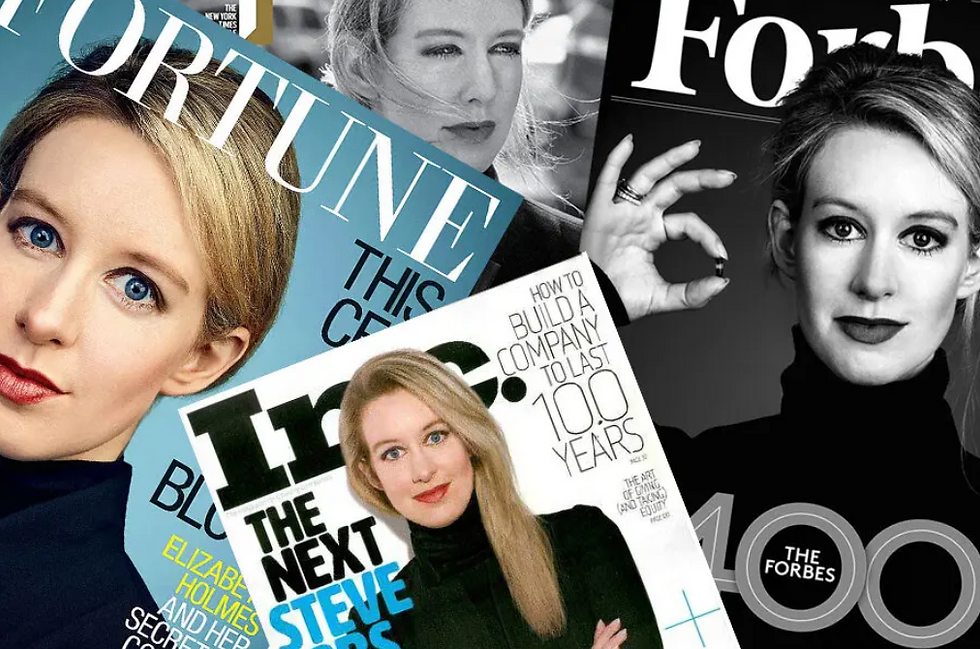
The consequences are visible in scandal coverage across industries, but one of the more absurd examples was the saga of Theranos. Elizabeth Holmes raised over $700 million on a story, a medical revolution that never existed. The media didn’t just fail to scrutinise her claims; they elevated her into a mythology of Silicon Valley genius, culminating in a Fortune magazine cover before basic due diligence had been performed [17].
Commentators later noted that Holmes succeeded not because she fooled investors, but because she fooled journalists first [18]. When the device collapsed into fraud trials, the self-reflection came later, meek and mostly on CNN [19].
Soft Power in HD
The Cambridge Analytica scandal illustrated what happened when data, media, and psychology merged. Using profiles harvested from millions of Facebook users, the firm micro-targeted political messaging to differentiate demographic groups during the 2016 U.S. election. A white suburban voter would receive fear-driven ads about immigration and status anxiety, while Asian voters were given culturally tuned appeals; not persuasion, but personalisation [14][15][16]. Cambridge Analytica was but a preview. Nations are now running digital influence campaigns, foreign outlets shape domestic narratives, and platforms decide which countries’ tragedies trend and which disappear beneath celebrity news. Soft power is algorithmic steroids managing feeds of individuals, influencing them in lieu of democracy.

Reality on Demand
Algorithmic media shatters the public sphere into micro-worlds that rarely collide. The gatekeepers have multiplied, but the gates have become invisible. Instagram, X, YouTube, and Facebook each curate a different universe of meaning. One user can live in a universe where climate change is an urgent catastrophe; another in a universe where it is a globalist conspiracy. One feeds on political nihilism, another on political fundamentalism. And neither knows the other is being primed. Humanity has been served and survived through misinformation long before the age of social media, which disarms misinformation and gives rise to a whole new realm of asymmetric information.
When two citizens in the same country, city, or classroom operate on entirely different factual baselines, it creates different realities. In one feed, immigration is a demographic necessity; in another, it is an existential invasion. In one universe, the climate is collapsing; in another, scientists are politically motivated alarmists. These worlds never intersect, because algorithms don’t optimise for epistemic cohesion; they optimise for engagement. And as engagement splinters, so does the public sphere. Democracies were never designed for parallel realities; deliberation assumes at least partial consensus on what is being deliberated. When that collapses, discourse becomes incoherent, politics becomes tribal, and governance becomes paralysed. The issue isn’t that lies spread; it’s that truths no longer converge.
When Truth Becomes Optional
There was a time when the greatest crisis of the media was censorship. Today, it is credibility. When every institution lies at least once, governments, newspapers, corporations, universities, and social platforms, audiences respond by withdrawing trust from all of them.
In such a landscape, cynicism feels rational. Cynicism, though, is not a shield; it is a vacuum. If you do not believe anything, you will believe what feels emotionally satisfying. That is the loophole through which conspiracy theories pass. The media helped create this world out of the misaligned incentives of speed over accuracy, access over accountability, and engagement over enlightenment, the deadly sins of information. In the pursuit of clicks, truth became negotiable; in pursuit of neutrality, context became disposable, and in pursuit of balance, false equivalence became a genre.
Who Own’s Tomorrow’s Reality
The future of media power sits at a crossroads between the domination of the government, corporations, platforms, or anarchy, each contributing to a different version of reality, one in which either reality becomes propaganda, product, or preferences, or fragments into tribes.
There is a path not yet taken, one where media literacy evolves into civic infrastructure rather than academic ornament. But literacy alone cannot solve the problem of incentives. Journalism needs to cost less to produce poorly and more to produce well. Outrage cannot be the cheapest currency of attention. Platforms cannot pretend neutrality while curating meaning.
For the first time in history, we are not guaranteed a shared reality; the question has changed from what is true to who decides what truth is allowed to compete. The decline of truth is not a cultural crisis but a crisis of governance. Headlines have become the battlefield of perception, and the war has only just begun.
Article by:
Merull Shah,
Editor,
PES MUN Society, RR Campus


Comments